
CARIAD | Volkswagen
Vehicle Emulator
From costly, hardware-bound testing to a flexible, software-driven simulation platform.
~$60K–$195K Est. Annual Savings • 72–96 Eng. Hours/Month Recovered • 3 Brands Supported • 0 → 1 Product Build
Overview
CARIAD's test engineers in Wolfsburg had one option for validating cloud signal behavior: a physical vehicle. Each test cycle required scheduling access, coordinating across VW, Audi, and Porsche lines, and committing a half-day to run what should have taken an hour. Leadership's directive was direct: reduce development and testing costs. The design challenge was building something engineers would actually trust as a replacement.
Lead UX Designer • 2 Designers • 3 Developers • 8 Engineers served • Wolfsburg

The Problem
A physical dependency at the center of every iteration.
Physical test vehicles at a Tier 1 OEM carry a loaded daily cost of $800–$1,500: depreciation, facility access, instrumentation, engineer time. For eight engineers running iterative signal tests across multiple sprint cycles, a single two-week sprint represented $2,400–$7,500 in direct vehicle testing costs before any coordination overhead.
Engineers weren't blocked on their code. They were blocked on their calendar.

$800–1.5K
Physical vehicle costs/day
~4 hrs
Lost per vehicle test cycle
3 brands
VW, Audi, Porsche
8 engineers
Target team, Wolfsburg HQ
* Cost figures are estimates based on OEM automotive testing industry benchmarks.
CONSTRAINTS THAT SHAPED EVERYTHING
We couldn't visit the users we were building for
The primary user base was in Wolfsburg. We were not permitted to travel there. Every insight had to be extracted remotely, requirements gathered asynchronously with German partners, stakeholder interviews conducted over video, workshop synthesis done without a shared room. Finding the right contacts took time the project didn't have. Once we had them, we protected every minute of access.
CONSTRAINT
No travel to Wolfsburg. All user research conducted remotely across time zones.
WHAT I'D DO DIFFERENTLY
I would have pushed back formally on the travel restriction. A single week on-site would have been worth more than a month of async research.
DEFINING THE SYSTEM
Two tools in one: built for different levels of sophistication
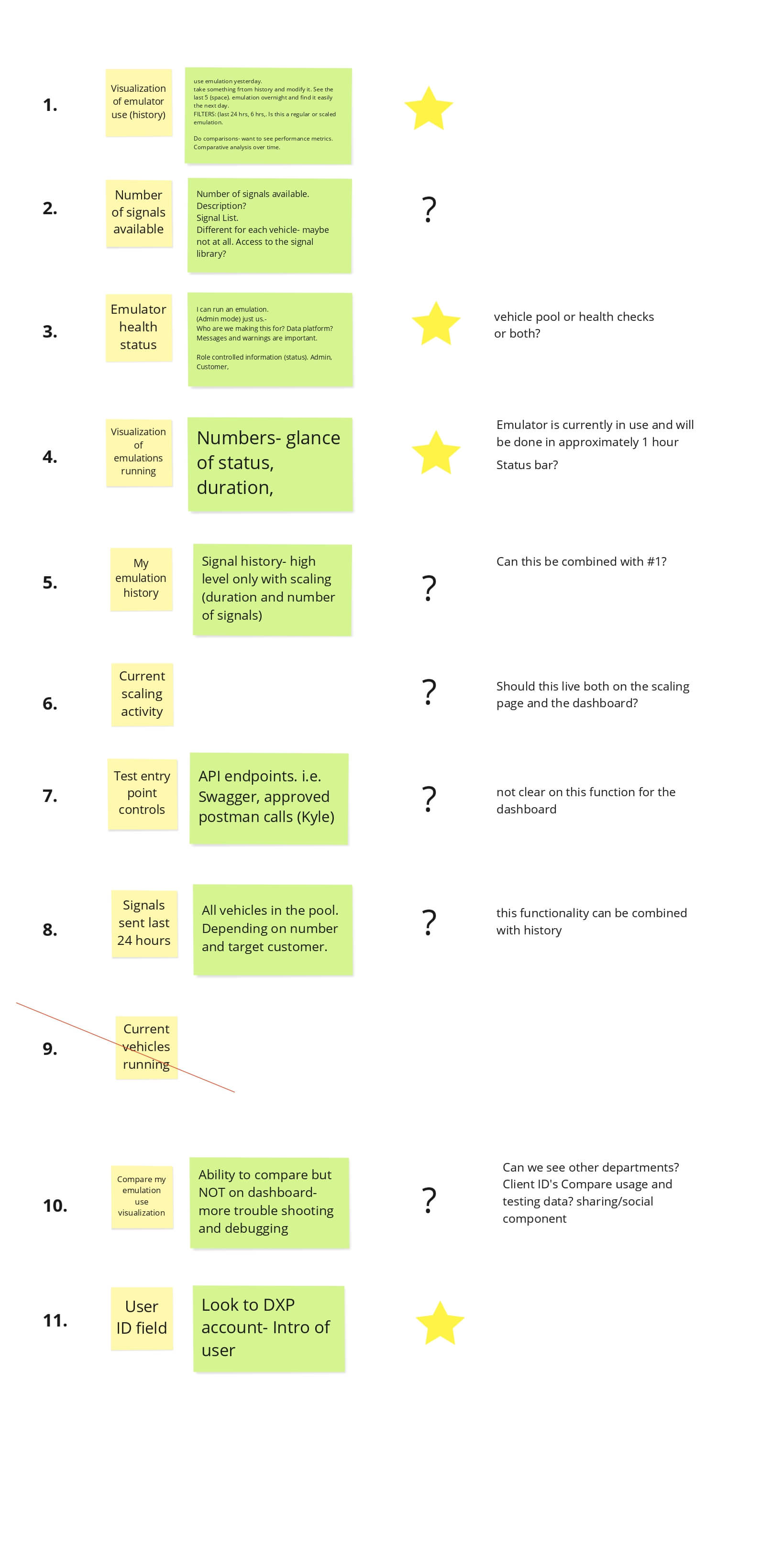
Before any high-fidelity design, the product needed a conceptual backbone. The emulator was two tiers: Emulator Basic for quick signal validation runs, and Emulator Studio for power users building, saving, and sharing reusable telemetry packages. Both had to feel like one coherent product.
The signal taxonomy alone required mapping the entire VW Group vehicle architecture: Engine, Ignition, Cooling, Electrical, Chassis, Suspension, Braking, and more; organized by system, searchable by name, and consistent across three brand lines.

DESIGN DECISIONS & TRADE-OFFS
The most important UX problem wasn't visual: it was anxiety
User Story 70435 captured something easy to miss: while the emulator prepared a scaling run, engineers needed a status update every 5–8 seconds just to know something was happening. Not a spinner. Actual progress language. Designing for that emotional state, the uncertainty of watching a process you can't see, shaped the entire notification architecture.
NOTIFICATION SYSTEM
3 states: green (running, valid), orange (action required), red (error). First-run authentication warning surfaced before engineers spent time debugging a certain issue.
MOBILE SCOPE
Research confirmed desktop as primary. Mobile designed for edge-case monitoring only, scoping it correctly freed engineering capacity for workbench depth.


FROM SKETCH TO SIGNAL
Three phases, one clear direction
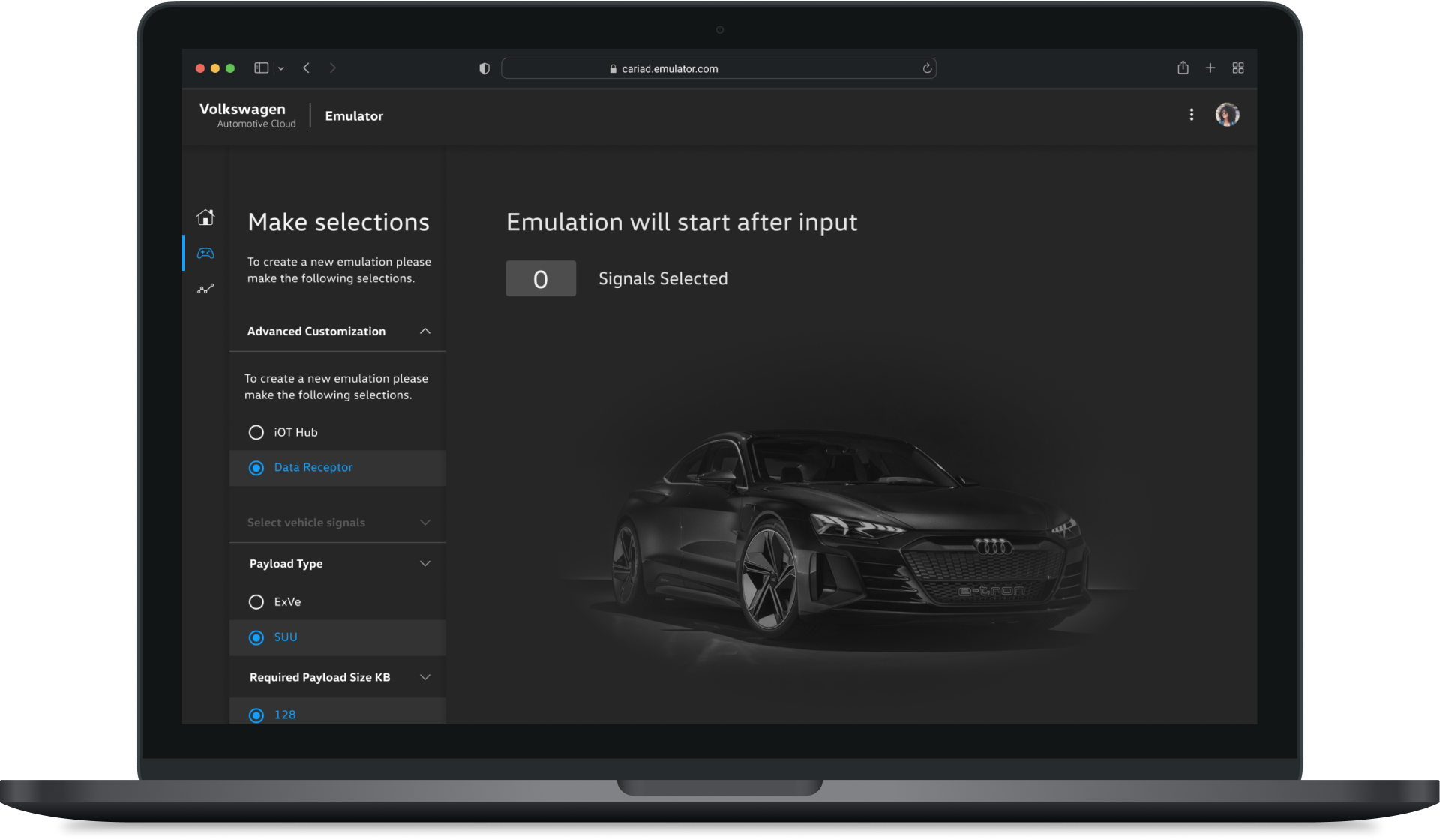
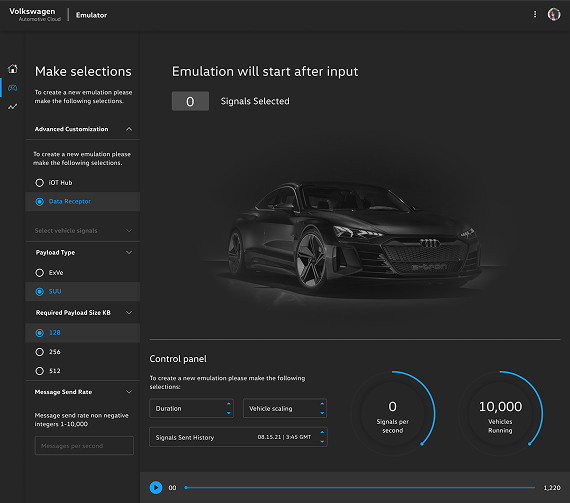
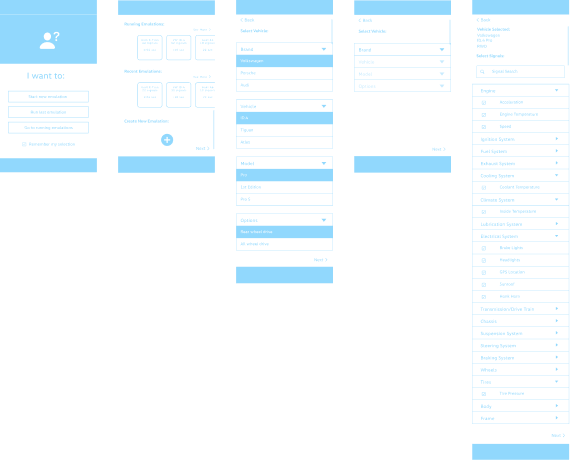
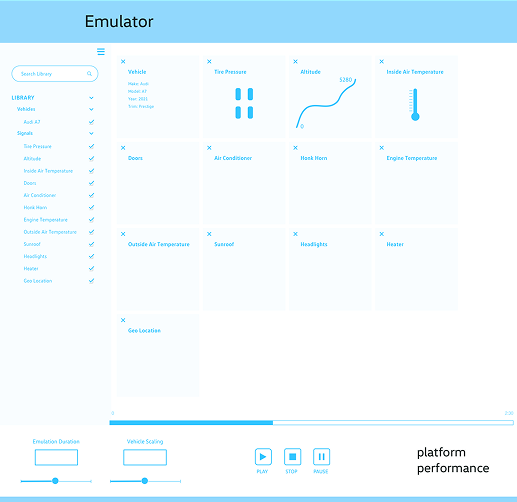
Early sketches resolved information grouping — left library panel, main signal canvas, bottom control bar. The wireframe phase validated the signal hierarchy model on both desktop and mobile. The final UI landed on a dark-theme workbench: signal cards in a responsive grid, timeline scrubber, vehicle scaling slider, and platform performance indicators anchored alongside playback controls. Dark theme wasn't aesthetic, it was an engineering environment convention that reduced eye strain and signaled technical context.
OUTCOMES & IMPACT
Concept validated. Groundwork established.
The emulator reached code testing; a meaningful milestone for a zero-to-one product built under geographic constraints. Early emulations were validated with engineers and the core concept proved sound. The project was paused when the team was redirected to a higher-priority initiative. That's worth naming clearly: the work was good enough to validate, and the organization made a hard prioritization call. Both things are true.

Vehicle Emulator
~$195K
Est. max annual savings, one team
96 hrs
Est. engineering hours recovered per month
14.4K
Est. monthly recovered eng. capacity
3
Brand lines supported at launch
* All figures are estimates based on OEM automotive testing industry benchmarks, not verified internal data.
Carried Forward
Design system patterns carried forward into subsequent CARIAD enterprise tools • Cross-functional collaboration model informed how later distributed projects were structured • Zero-to-one product experience directly applicable to later platform work • Demonstrated business value of UX investment in reducing hard engineering costs
© David Fite 2026
© 2026 David Fite